Farm Equipment Finance Information For Australian Farmers
Explore practical farm equipment finance information for Australian farmers and agribusinesses. Learn how loans and leases can spread the cost of tractors, harvesters, irrigation systems and more, including the role of flexible terms and seasonal repayments. Read about how to finance farm equipment in Australia and what to consider when comparing rates and options.
Farm equipment finance information for Australian agriculture
Farm-equipment-finance.com.au focuses on agricultural equipment loans, tractor financing, harvester finance and more, aligned with the realities of seasonal cash flow. Explore clear explanations, comparisons and tools to help you choose funding that supports productivity, growth and long-term resilience.
Use our resources to understand options for new and used machinery and explore low-doc farm equipment finance concepts. Learn what to consider when comparing farm equipment loan rates in Australia. You can subscribe to MoneyTips for financial information, news, guides and resources or learn more about us on the About page. This website provides general information and tools, not personalised advice, finance applications or broker referrals.
Why finance your farm machinery and vehicles?
Preserve working capital: Keep cash free for inputs, wages and unexpected repairs instead of tying it up in large purchases.
Align repayments with seasons: Structure agricultural equipment loans around harvest or sale periods to ease off-season pressure.
Upgrade when you need to: Access newer tractors, harvesters, sprayers and irrigation systems without paying the full purchase price upfront.
Support farm expansion: Use farm asset financing to add additional machinery as your operation grows.
Explore potential farm equipment finance scenarios with our Farm Equipment Finance Calculator. Test different deposit amounts, trade-in values, residual (balloon) payments and loan terms to estimate repayments and see how varying assumptions may affect your farms cash flow.
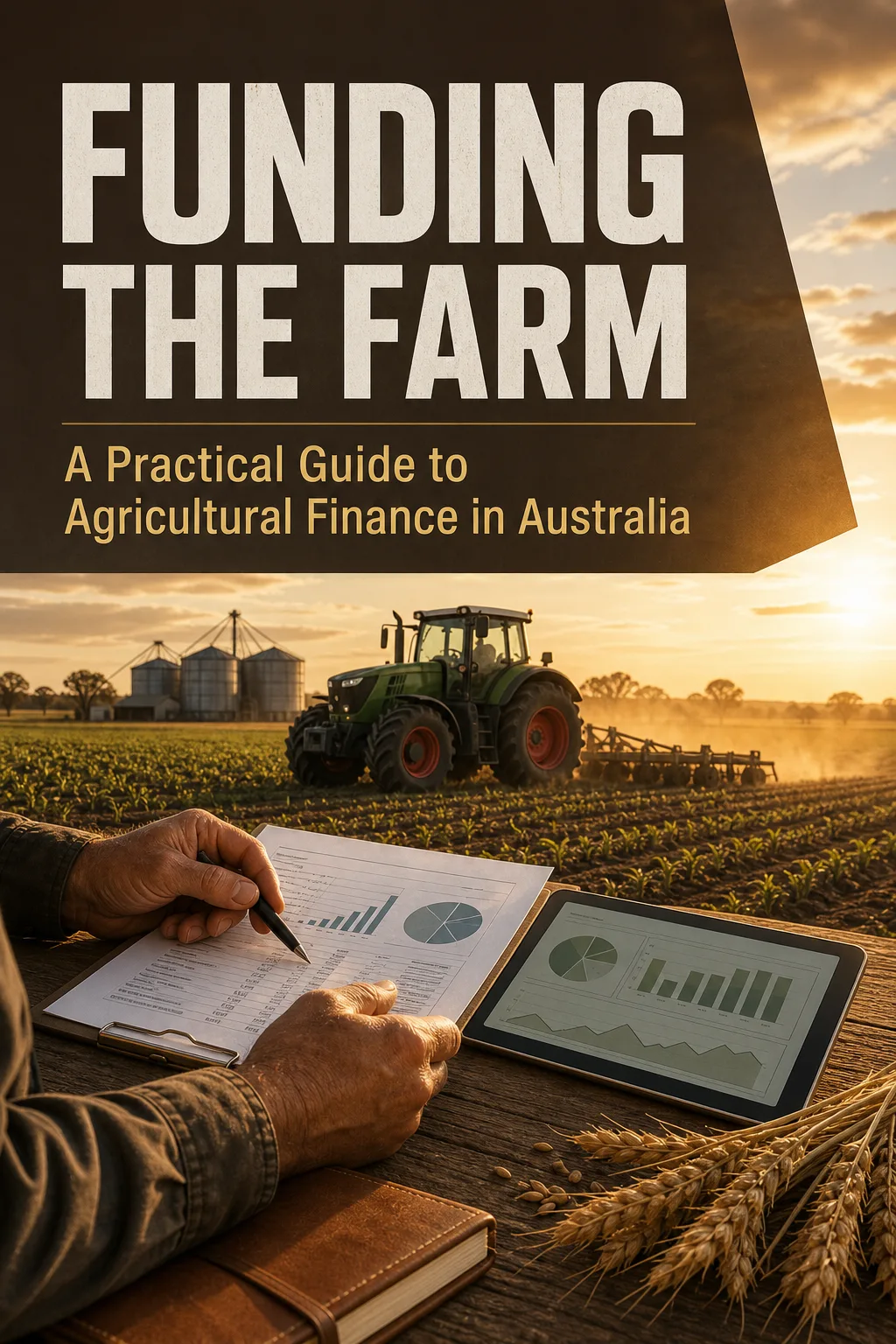
Funding the Farm: A Practical Guide to Agricultural Finance in Australia
Finance can shape the future of a farming operation, from buying land and upgrading machinery to managing seasonal cash flow or refinancing existing debt. This practical guide explains how farm loans, agricultural loans and rural finance work in the Australian context.
Written for farmers, primary producers, rural property buyers and agribusiness owners, it covers lender expectations, business planning, loan structures, rates, fees, equipment finance, working capital and rural property purchases.
With checklists, case studies and FAQs, it helps readers prepare more confidently for finance discussions and compare options with greater clarity.
Different funding structures suit different farm businesses. Understanding the options helps you choose repayments and ownership outcomes that fit your plans.
From traditional agriculture machinery loans to farm machinery leasing and hire purchase, each finance type has its own approach to ownership, tax treatment and flexibility. Farm businesses may consider different options across tractors, harvesters, farm vehicles and irrigation system loans.
Our articles explore how to finance farm equipment in Australia. When researching livestock equipment finance and rural equipment finance, consider lenders' eligibility criteria as well as costs and terms. You can explore comparisons in our articles, but as with any finance arrangement it is important to consider both the benefits and the risks, including your ability to meet repayments in variable conditions, and to seek independent advice on suitability for your circumstances.
Thoughtful repayment planning can make farm equipment finance more manageable across good seasons and tough years.
Shape repayments around expected harvest or livestock sale dates.
Consider structured balloon payments to lower regular instalments.
Review options for interest-only periods during major upgrades or expansion.
Off-season periods and changing commodity prices are important considerations when planning repayments. Use our farm finance calculators to estimate repayments based on the inputs and assumptions used. Results are general estimates, not quotes, offers, approval or eligibility assessments.
Beyond loans and leases, explore news and insights on farm productivity and equipment upgrades for Australian farmers and agribusiness owners. Case studies examining financing decisions, costs and trade-offs are planned editorial topics.
Tools, guides and updates for informed financing decisions
Use our calculators, news updates and educational content to stay informed about interest rates, loan terms and opportunities across the agricultural sector.
New vs used farm machinery finance
Financing used farm machinery can be an effective way to upgrade capacity while managing costs, but there are trade-offs to consider.
Understand how loan terms and rates may differ for new versus used agricultural machinery.
Compare total cost of ownership, including maintenance and expected lifespan.
Review how tractor financing, harvester finance and farm vehicle financing can be structured for pre-owned assets.
When comparing new and used equipment finance, consider equipment condition, expected lifespan, borrowing costs and production goals.
This week: the federal backdown on backpacker visa changes aims to steady farm labour supply, but growers warn uncertainty remains. Landline showcases on?farm automation, with driverless tractors and machine harvesting used to ease peak?season pressure. The program also spotlights battery?powered trailers being trialled to cut diesel use in heavy freight, while approvals and charging access evolve. Heatwave warnings across Far North Queensland raise machinery fire risks and slow harvest schedules. Takeaways: secure labour early, run the numbers on automation versus contracting, model transport paybacks, and allow cash?flow buffers and seasonal repayment structures to handle weather disruptions.
Some lenders offer low-doc farm equipment finance solutions designed to reduce paperwork and speed up access to essential machinery.
Potentially quicker approvals for established farmers with strong repayment histories.
Reduced documentation compared with full financial statement loans.
Options that may suit time-poor producers needing rapid upgrades.
When considering low-doc options, compare documentation requirements, costs and terms with those of a full-documentation application. Eligibility and approval times for low-doc farm equipment finance vary between lenders and individual applicants, and not all borrowers will qualify for reduced documentation or faster processing.
Australian heavy freight is starting to test a new middle ground between conventional diesel trucks and fully electric prime movers, with battery-powered trailers emerging as a possible way to cut fuel use without replacing the truck upfront. For farmers and agribusinesses that rely on livestock, grain, hay, fertiliser or machinery transport, the development is less a simple technology story and more a capital-planning question. - read more
Australian machinery buying appears to have cooled again, with October tractor sales reportedly falling after a more encouraging September. For farmers planning replacements, the latest Tractor and Machinery Association of Australia figures are less a reason to assume bargains will automatically appear and more a reminder to test upgrade timing, repayment capacity and the true cost of keeping older gear in service. - read more
ABC Rural reporting from Tasmania has put a fresh spotlight on how quickly dairy equipment decisions are moving from single-machine purchases to connected operating systems. A north-west Tasmanian dairy farm has been profiled as Australia’s first to combine GPS-enabled virtual fencing collars with robotic milking, using animal data, automated movement and milking hardware to reduce the amount of hands-on labour needed to bring cows through the dairy. - read more
Recent rural reporting on diesel price pressure and a high-horsepower tractor completing a renewable-fuel journey through Western Australia are sharpening a practical finance question for farmers: when machinery is assessed, how much weight should be given to fuel use, energy flexibility and operating resilience, not just the upfront purchase price? - read more
Tractors are the backbone of modern farming, revolutionizing the way we cultivate and manage farmland. From plowing fields to sowing seeds and reaping harvests, tractors significantly increase efficiency and productivity on the farm. - read more
New and used farm machinery can both be financed, but lenders may assess each purchase differently. This guide explains the practical factors farmers should consider, including asset age, condition, valuation, documentation, warranties, resale value and repayment planning. - read more
Applying for farm equipment finance usually involves showing how the asset will support your operation, how repayments may be managed and what financial information a lender needs to assess the application. - read more
Irrigation systems play a crucial role in the success of farming operations in Australia. With unpredictable weather patterns and the vast dryland areas, having an efficient irrigation system can significantly enhance crop yields and sustain production during periods of low rainfall. From increasing water efficiency to improving crop quality, the benefits are numerous and indispensable for modern agriculture. - read more
Knowledgebase
Blue Chip Stock: Shares in a large, reputable, and financially stable company with a history of reliable earnings and dividend payments.